
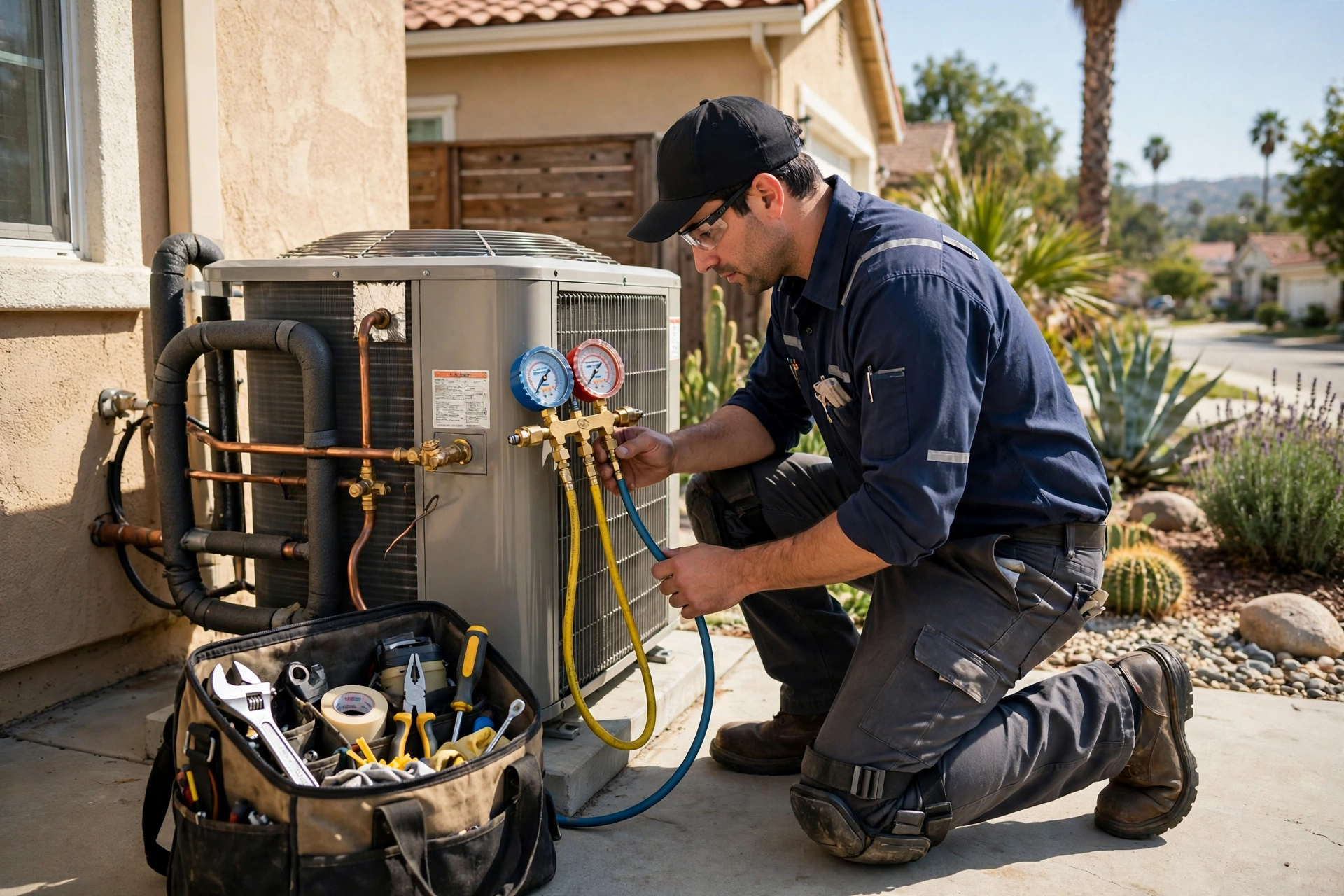
Why Is My AC Not Cooling?
An air conditioner that runs all afternoon and never cools the house usually has one of a small number of causes. Here are the checks, in the order a technician follows them.
Read More →An air conditioner that runs but does not cool, a furnace that gives no heat on a cold morning, a mini-split that stopped working, or a unit making a strange noise — describe the fault and get a diagnosis and a clear repair plan.
24/7 emergency line • Serving Aliso Viejo, CA
A summer afternoon in Aliso Viejo can reach the low 80s, and when the air conditioner stops cooling, the house warms up fast. Many calls start with the same plain words: the air conditioner is not cooling properly, or the unit is running but it is not blowing cool air. Others are simpler still: my air conditioner is not working. This page explains what usually causes those faults in Aliso Viejo homes, what a diagnosis checks first, and what happens next when a repair is needed.
Aliso Viejo is a master-planned community in Orange County, incorporated in 2001, and most homes were built between 1982 and the early 2000s. Many of those homes still run their original heating and cooling systems, now 25 to 40 years old. The Mediterranean climate keeps winters mild, so air conditioning carries most of the workload, and a system that has cooled the same home for decades is the one most likely to show its age in August. The sections below follow the problem first, then the solution, so a homeowner can tell what kind of fault they have before they call.
When an air conditioner runs but does not cool, a diagnosis works through the system in order: thermostat, filter, airflow, refrigerant, and the outdoor unit. The thermostat is checked for mode, set temperature, and a live display. A filter clogged with dust is checked next, because restricted airflow can freeze the indoor coil and stop cooling altogether. Then the refrigerant charge, the indoor coil, and the outdoor condenser are tested in turn.
Callers often describe the fault in the same few words: the air conditioner is set at 72 but it is not getting below 80, or the unit is cooling but not enough. That pattern — running, blowing air, but not cooling — usually points to low refrigerant, a dirty coil, a failing capacitor, or a compressor that will not start. A diagnosis separates those causes by measuring temperatures and pressures, so the repair matches the cause.
Some faults are easy to describe and hard to guess at: a unit that blows warm air, a fan that will not spin, or a breaker that trips each time the air conditioner runs. Each of those points to a different part — the capacitor, the fan motor, the compressor, or the electrical supply. Working through the checks in order gives a clear answer about what failed, and the repair plan follows from the fault found.
Mini-split systems are common in Aliso Viejo homes, cooling bedrooms and additions that the main system does not reach well. A mini-split that stops working often shows the fault plainly: one indoor head does not respond, the unit shows an error code, or water leaks from the indoor unit onto the wall or floor below. Those signs point to the indoor head, the drain line, or the outdoor unit.
Mitsubishi and Fujitsu are two brands seen often in these calls, and both use error codes that narrow the fault down: a code can point to a sensor, a communication fault, or a refrigerant problem. Callers describe the moment plainly — the mini-split just hissed and stopped working, or the mini split is leaking water. A diagnosis reads the code, checks the drain, and tests the outdoor unit before any part is changed.
Mini-splits also need their own maintenance: indoor filters cleaned, the drain line cleared, and the outdoor coil kept clear of leaves and debris. A mini-split that cools weakly in one room while the others stay cool may have a dirty filter, a blocked drain, or low refrigerant. The checks are small, but they are specific to ductless systems, and they are done before a repair is planned.
Many Aliso Viejo homes still run the heating and cooling system installed when the house was built, and at 25 to 40 years old those systems are past the age most units were designed to serve. The decision between repair and replacement starts with the fault itself: a failed capacitor or a clogged drain is a repair, while a failed compressor on a system that has already had several repairs is a different conversation.
Callers reach that point in plain words: the HVAC unit needs to be replaced because it stopped working, or a homeowner asks for a quote on a new air conditioner. Sizing matters here — a 3.5-ton system is a common size for the larger homes in Glenwood and Pacific Ridge, and the right size depends on the home, its insulation, and its ductwork, not on the size of the unit being removed.
A diagnosis gives the facts the decision needs: the part that failed, the age and condition of the rest of the system, and whether the repair restores the cooling the home needs through the summer. Replacement is planned when repairs keep repeating or the system can no longer cool the home on the hottest days. Either way, the choice follows the diagnosis, not the other way around.
Aliso Viejo winters are mild, with lows around 46 to 47 degrees, so furnaces run far less here than in colder parts of the country. That does not mean they never fail. The most common winter call is simple: no heat, or a furnace that will not turn on when the temperature drops overnight. A diagnosis checks the thermostat, the igniter, the flame sensor, and the gas or electric supply in order.
Some furnaces try to start and then stop, or light and then drop out within a minute — a pattern called short cycling. Others blow cool air because the burner never lights. Callers describe it plainly: the heater is not working, or the heat is not kicking on. Those patterns point to ignition, flame sensing, or control faults, and each is tested before a part is changed.
Because furnaces sit idle through the long warm season, a first cold night in late autumn can reveal a fault that has waited months to appear. A pre-season check covers the filter, the burner, the igniter, and the safety controls, so a fault is found while the weather is still mild. Gas and electric furnaces both appear in Aliso Viejo homes, and each has its own checks.
A tune-up is booked in spring, before the summer heat arrives. The visit covers the filter, the indoor and outdoor coils, the condensate drain, the refrigerant charge, and the electrical connections, so faults are found while the weather is still mild and the system can be tested under a real cooling load.
Many homeowners ask for exactly that timing: a service of the air conditioner before summer, a filter change, and a check that the unit cools the way it should. For systems that have run for decades, the visit also looks at wear — a capacitor that is weakening, a fan motor that is drawing more current than it should, or a drain line that is starting to clog.
The condensate drain deserves its own mention. Aliso Viejo summers are dry, but an air conditioner still pulls moisture from the air, and a clogged drain can send water onto the floor below the indoor unit or trip a safety switch that shuts the system off. Clearing the drain and the trap is part of a tune-up, and it prevents one of the most common summer leaks.
Uneven cooling is a common complaint in two-story Aliso Viejo homes: the downstairs stays cool while the upstairs rooms stay warm, or one room never reaches the set temperature. The cause is often in the ductwork — a disconnected run, a closed damper, or a duct that loses cool air into a hot attic — rather than in the air conditioner itself.
Thermostats cause their share of uneven cooling too. A thermostat with a blank display, a thermostat that shows no power to the red wire, or a thermostat placed in a spot that does not reflect the rest of the house can all leave rooms uncomfortable while the system itself is sound. Checking the thermostat setting, the display, and the batteries is the first step before any duct or equipment work.
Humidity is the third piece. An air conditioner that runs but leaves the house humid may be short cycling, or it may be oversized for the home, cooling the air so fast that it never runs long enough to pull moisture out. A diagnosis measures temperature and humidity together, so the fix matches the cause — a duct repair, a thermostat change, or a system that needs a longer look.
Repair cost is shaped by four factors: the part that failed, the age and type of the system, the size of the system, and access to the unit. A capacitor or a drain clearing costs less to put right than a compressor or a control board, and parts for older systems can take longer to source.
Age and type matter because a repair on a 30-year-old unit is weighed against the condition of the rest of the system. A single repair on a system that has otherwise run well is one thing; repeated repairs on a system that is already struggling to cool the home is another. The diagnosis lists the part, the system age and type, and the condition of the other components, so the choice is based on what was found.
Access shapes the work too. An outdoor condenser on a hillside lot in Pacific Ridge, an indoor unit tucked into a tight attic, or a mini-split head mounted high on a bedroom wall all take longer to reach and test than a unit in an open garage. A clear diagnosis lists the part, the system age and type, the system size, and the access involved, so the homeowner can see what drives the work.
Our Services
HVAC systems fail in different ways for different reasons. Each service below covers one kind of problem — so the right fix is applied where the fault actually is.
Diagnosis and repair for air conditioners that are not cooling, blowing warm air, leaking water, or will not start — covering refrigerant, coils, capacitors, fans, and compressors.
Repair for ductless mini-split systems that stopped working, show an error code, leak water, or cool one room and not another — including Mitsubishi and Fujitsu systems.
New air conditioner installation and replacement of aging systems, with sizing matched to the home, ductwork, and cooling load.
Diagnosis and repair for furnaces with no heat, ignition faults, short cycling, and blowers that will not start, for gas and electric systems.
New furnace installation and replacement of older heating systems, with venting, gas and electrical connections, and a clear handover.
Seasonal tune-ups before summer covering filter, coils, condensate drain, refrigerant charge, and electrical checks.
Repair for heat pumps that will not heat or cool, short cycle, or struggle on mild winter nights, including dual-fuel setups.
Repair and replacement for thermostats with blank displays, no power, wrong readings, or a system that will not respond.
Duct repair for disconnected runs, leaks, and dampers that leave rooms warm, with airflow checked at the register.
Help for heating and cooling faults that cannot wait — no cooling on a hot day, no heat on a cold night, or water leaking from the system.
Heating and cooling repair for shops, offices, and other commercial buildings in Aliso Viejo, planned around the system in place.
Why Choose Us
What you can expect when you call Aliso Viejo HVAC Pros about an HVAC problem.
Call (949) 555-0100 any time your cooling or heat goes out — day or night.
HVAC repair across Aliso Viejo, from Glenwood and Pacific Ridge to Westridge, Canyon Vistas, Laguna Audubon, Town Center, and California Summit.
Describe the fault and get a clear diagnosis and repair plan before any work starts.
A referral service that connects you with independent local HVAC providers.
Air conditioners, furnaces, heat pumps, and mini-splits — gas and electric systems alike.
Cooling help built around Orange County summers, from August heat to inland heat waves in the 90s.
How It Works
Three simple steps from the first call to a comfortable home again.
Call and describe what the system is doing, or not doing, in your own words. Note when the fault started, which rooms are affected, and any noise, smell, or error code you have seen.
The fault is traced through thermostat, filter, airflow, refrigerant, ignition, and the outdoor unit in order. Each test narrows the cause, so the repair plan matches the fault found.
The repair is carried out, then the system is run through a full cooling or heating cycle to check output, airflow, and controls before the visit ends.
Areas
Serving homeowners across Aliso Viejo — neighborhoods below.
Don’t see your neighborhood? Call us — if you’re in Aliso Viejo, we cover it.
FAQ
Common questions from Aliso Viejo homeowners about HVAC repair.
Low refrigerant, a dirty coil or filter, a failing capacitor, or a compressor that will not start are the usual causes. A diagnosis measures temperatures and pressures to find which one is stopping the cooling.
Check the thermostat mode and set temperature, whether the display is live, the breaker, and the filter. Note any noise, error code, or pattern, such as the unit starting and then stopping, and share those details when you call.
The code narrows the fault down to a sensor, a communication problem, or a refrigerant issue, depending on the brand and model. Write the code down exactly before switching the power off and on, because the code is the fastest clue to the cause.
A clogged condensate drain or trap is the most common cause, and a frozen coil or a cracked drain pan can do the same. Shut the system off if water is pooling, and note where the water is coming from when you call.
It depends on the part that failed, how often the system has needed repairs, and whether it still cools the home on the hottest days. A diagnosis gives those facts first, so the choice is based on the condition of the system, not on its age alone.
Spring, before the summer heat arrives. The visit covers the filter, the indoor and outdoor coils, the condensate drain, the refrigerant charge, and the electrical connections, and leaves time to plan a repair if one is found.
Four factors: the part that failed, the age and type of the system, the size of the system, and access to the unit. A diagnosis lists those factors so the homeowner can see what drives the work.
From the Blog
HVAC guides for Aliso Viejo homeowners — what causes the fault, what a diagnosis checks, and what happens next.
An air conditioner that runs all afternoon and never cools the house usually has one of a small number of causes. Here are the checks, in the order a technician follows them.
Read More →An air conditioner that will not turn on at all is a different fault from one that runs and does not cool. The cause is usually electrical, and a few quick checks can separate a simple fix from a fault that needs a technician.
Read More →
A mini-split that stops working leaves one room warm while the rest of the house stays cool. The fault often shows itself plainly — an error code, water dripping from the wall unit, or a remote that does nothing at all.
Read More →Water dripping from an air conditioner usually comes from the condensate drain — the line that carries moisture out of the indoor unit. When that line clogs, the water has nowhere to go but onto the floor below.
Read More →
Every aging air conditioner reaches a point where the question changes from what is wrong with it to whether it is worth fixing. The answer is not in the age alone — it is in the fault, the repair history, and how the system performs on the hottest days.
Read More →Inspection first. Honest answers. Repair and replacement by local providers.
Call (949) 555-0100